Mixed Lower-Leg Ulcers
Wound Care · Life Eugene Marais Hospital, Pretoria
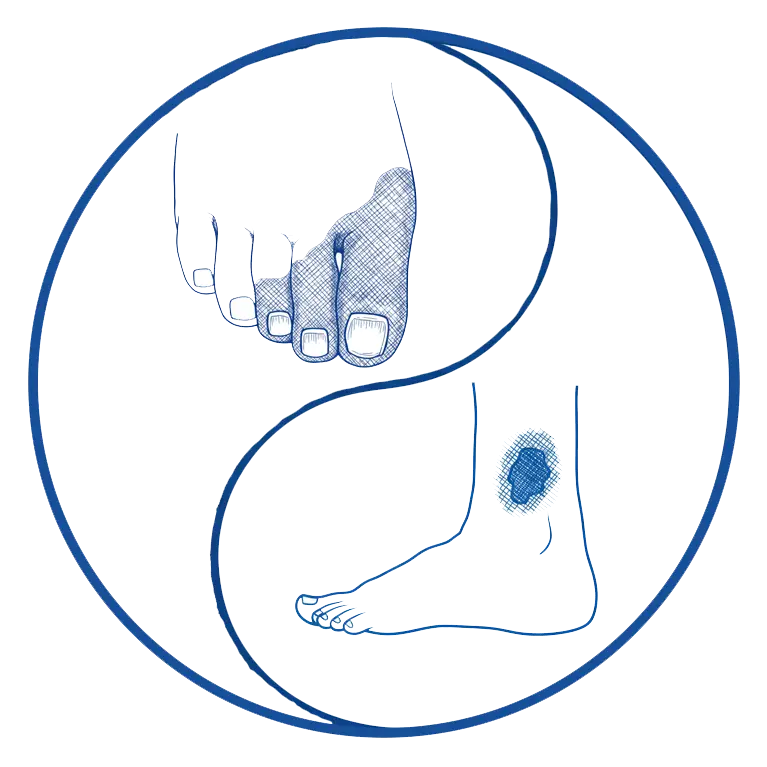
Patients with both arterial and venous insufficiency may develop stubborn lower-leg ulcers — among the most challenging wounds to treat. The venous component usually requires compression, while the arterial component can make compression dangerous; an accurate assessment of the blood supply is therefore essential before treatment begins.
Diagnosis at our practice
A complete medical history and clinical examination is followed by a hand-held Doppler examination to determine whether the arterial supply to the limb is adequate. Where indicated, arterial and/or venous duplex-Doppler studies are performed to confirm the diagnosis. We also have specialised equipment for transcutaneous oxygen measurement (TcPO2), which establishes exactly how much oxygen is available at the wound for healing.
Treatment
- Accurate assessment first — Doppler, duplex-Doppler and oxygen measurement establish which component dominates and whether compression can safely be applied.
- Basic and advanced wound care — including negative-pressure wound therapy (VAC) where indicated.
- Arterial revascularisation — if conservative wound care does not deliver the needed results, it may be necessary to improve the arterial supply before the wound can heal.
- Hyperbaric oxygen therapy — for selected complex cases that do not respond as expected.
When should you seek help? If your wound does not improve within 7 days of appropriate basic wound care, you need a wound care specialist. If the wound has not improved as expected after 6 weeks of specialist care, you need a consultation with a vascular surgeon.
Educational videos
 Nonsurgical Management of Chronic Venous Insufficiency
 Arterial Revascularisation
 Pentoxifylline and Venous Leg Ulcer Healing
Frequently Asked Questions
What makes a mixed ulcer so difficult to treat?
The venous component needs compression, but the arterial component can make compression dangerous. Treatment must therefore be tailored precisely to your situation, based on a thorough vascular assessment.
Will I need an operation?
Not necessarily. Many patients respond to conservative wound care. If the arterial supply is too impaired, however, Dr Weir will discuss the revascularisation options with you.
Do you treat patients without medical aid?
We can only treat patients with active medical aid cover. Private patients without a medical aid will unfortunately have to be referred elsewhere.
Do you have a chronic wound that will not heal?
Tel: 012 335 8651 · WhatsApp: 061 520 4140 · Email: [email protected]
Please note that we can only treat patients with active medical aid cover.